Showing posts with label Pine. Show all posts

Friday, February 19, 2016

Operations in Chile

Working in the timber industry in Chile, has been fascinating. Forestal Mininco, a component of CMPC, is the second largest timber company in Chile.   Their influence on communities and local economies is significant to southern regions. 


I can say that my Oregon State University education has prepared me very well to discuss similar harvesting systems, plantation regimes, and landscape management.  They are not so far off from what I have experienced in my work in Oregon and British Columbia.  Steep slope harvesting, road placement, negative public perception, and indigenous conflicts are consistent topics throughout my experiences on both continents.


What I find most noticeable is that Chile’s developed industry is relatively new.  It was just in the last forty years that the forestry sector looked similar to how it operates today. Furthermore, the conflicts between indigenous peoples and landownership continue to significantly influence harvesting operations through acts of property destruction. 

The forestry sector is a dynamic resource that the world relies on for an incredible amount of products. Chile is a country that provides a significant portion of pulp products and sawlogs worldwide.  I have gotten an inside look at the harvesting operations process in the private industry.
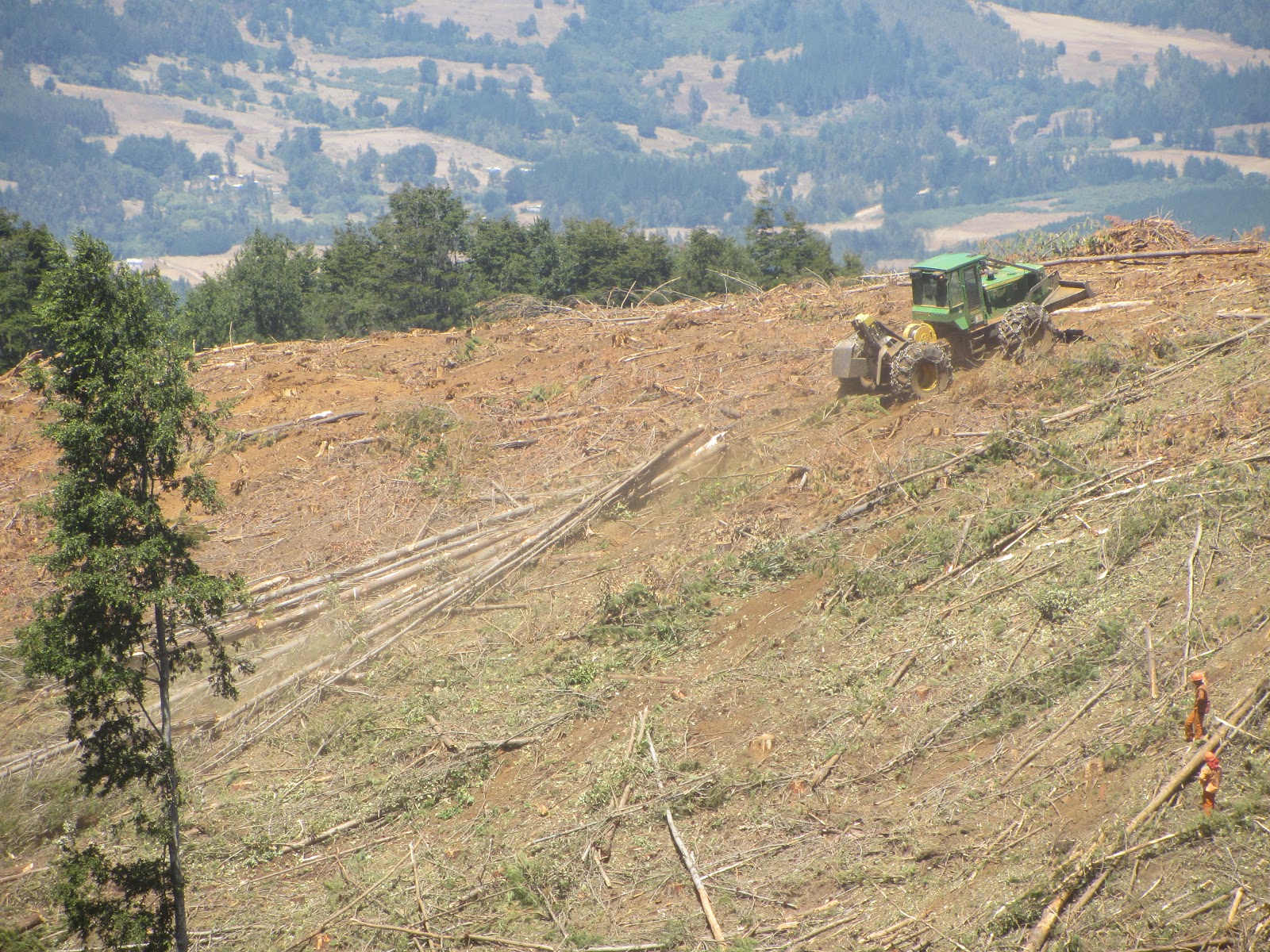
While the coolest pictures are of the operations in action, most of my days are spent meeting with all those involved in running the show. I am familiar with the optimization and heuristic programs professionals utilize daily to most efficiently produce wood products.  I learn the complex transport system that runs over 1,200 loads daily and 600 nightly.  I recognize the planning that goes into assigning hundreds of contract companies to harvest schedules.  Then I understand the negotiations that go into product sales to the mills based on the capacities of the composition of the plantations. 

I have to say it has been a fun ride to understand a small piece of the organization CMPC and Forestal Mininco.


Monday, January 25, 2016

CMPC: Forestal Mininco


CMPC is an integrated organization composed of four components: forest, paper, tissue, and pulp products. And integrated company means that they own all of the links of the process to produce a product, in this case various wood products.

http://www.cmpc.cl/

CMPC has forest lands and factories throughout Central and South America that sell to markets across the world. Forestal Mininco is the forest management division within CMPC. The 500,000 hectares of forest plantations in Chile are composed mostly of radiata pine and eucalyptus to produce a multitude of products ranging from pulp and paper to sawlogs and plywood. The regions are separated in to patrimonios and into smaller areas called fundos which are composed of stands or rodales. Annually Forestal Mininco produces 5 million cubic meters of wood products and plants over 20 million trees in radiata pine trees alone!

The focus of my work with Forestal Mininco includes improving the recuperation of value in the silviculture and operations systems of radiata pine.
Radiata pine can produce many more economically valuable products such as plywood, sawlogs, and plywood.  Do you know what a peeler log is? Check out this link!  This video shows part of the process of making plywood.

La cosecha y el manejo en general - Harvest and Management Practices
Intense management of radiata pine plantations in southern Chile produces quality sawlog and peeler products. In general the pine trees are planted on prepared soil with added nutrients and treated once initially with herbicides to control competing vegetation. Pruning occurs up to three times beginning as early as four years after planting. Thinning the initial density of approximately 1.200 trees per hectare occurs up to two times before final harvest with a final density around 400-500 trees per hectare after about 24 years of growth. The stand silvicultural treatments depend on the soil type, growing conditions, and water availability.

The practices are highly analyzed and tested in order to incorporate the highest producing management schemes by the research and development teams. Variation in density, thinning schedules, and pruning grades produce different outcomes depending on the desired outcome. The objective of the current projects surrounds high grade peeler logs of radiata pine.