Showing posts with label Society of American Foresters. Show all posts

Wednesday, March 16, 2016

Baby trees, search for the cures


There is something special about looking across a field of 20 million tree seedlings. The vibe is obviously present in the 160 hectare nursery located just outside of Yumbel, in Region 8.  The magic of millions of trees growing side by side under detailed care by the hundreds of people that work to maintain high quality plants.  The energy of a nursery stems from the excitement of making growth. The detailed procedures that are conducted to produce the best results are critical to the survival and growth potential of  the millions of trees that are planted for Forestal Mininco´s plantations.  


The Carlos Douglas Vivero (Nursery), is where the baby trees come to life. They are the livelihood and sustainability of forestry for all of the company´s plantations in Chile. The nursery produces approximately 40 million seedlings annually! They use various techniques to produce these trees that will be planted throughout the country. The majority of their products are radiata pine, eucalyptus globulus, and eucalyptus nitens.  They also have a smaller stock on native plant species to contribute to local community projects and gardens.  The many acres and seed beds are rotated and closely managed for high quality and successful establishment.  Some fields are managed to produce sillage for organic matter.  This material is critical to the nutritional capacity of the soil matter.
The trees are established through a variety of methods, firstly through seeds or cuttings.  These come from mother plants grown on site or at the bio laboratory.  They can be in the form of plugs, with soil, or bareroot, grown in ground.  The pine seedlings gain sufficient growth in 8-12 months.  They are graded and groomed to a certain height and diameter.  The eucalyptus seedlings grow much faster and are ready after 6 months.  They are exclusively grown from seeds whereas other hybrid species are from cuttings.  They are planted in coconut fibers for further plant enhancement.

The nursery is managed by Forestal Mininco and work is conducted by over 300 contracted workers.  A workforce mostly of women, do the daily tasks of planting, sorting, moving, cutting, packaging, etc of maintaining the trees. The busy season starts up in April and May as colder weather sits in in Chile.  The packaging and transport of seedlings can last well in September depending on the weather patterns.  As the older seedlings leave the new sowing can begin as the space is freed up.  It is a constant rotation and shuffling of space and storage.

The nursery works closely with the tree improvement research conducted by Forestal Mininco researchers and labs.  Their goal is to improve the growth potential, tree form, and wood properties.  This project was started as a cooperative program in Chile in order to find the best genetic material among forest plantations.  They have improve volume gains 35% in the last 40 years.  The mission of plantations are to produce as fast as possible high quality and successful plantations.

The Carlos Douglas Nursery is an FSC, Forest Stewardship Council, certified operation. As a critical link in the CMPC production chain, the nursery follows certain procedures to ensure that their operation aligns with the guidelines required with this certification. In particular, it limits the use of chemicals that would otherwise limit weeds in bareroot production.  This leads to greater labor cost because it is instead done by hand.  The certification also encorporates strong engagement in the social issues for workers and surrounding communities.  While water use was not mentioned as a guideline for certification, the nursery is limited to water for its cost and amount aloud by the government.  The nursery monitors all water entering and exiting the system to maintain minimal impact on surrounding systems.


Sunday, November 30, 2014

IUFRO & SAF/CIF World Congress 2014

IUFRO & SAF/CIF World Congress 2014Salt Lake City, Utah, USA


IUFRO = International Union of Forest Research OrganizationSAF = Society of American ForestersCIF = Canadian Institute of Forestry


Breakfast in Bend on our way to SL

For the first time ever three international forestry organizations collaborated for the world’s largest forest professional gathering ever! A combination of over 6,000 people from around the world congregated to learn cutting edge research discoveries, network with new colleagues, and learn from peers. 

Opening Ceremony featuring Native American
from South Western tribes. 
Joining the Oregon State University Chapter of SAF in Corvallis, OR we made the long drive to Salt Lake City, Utah in one day.  There were 12 of us embarking on this trip with the support of OSU College of Forestry and Oregon SAF Chapter.  Fundraising and organization mostly by our Chair, Sam Delano we were down for the adventure.  Kudos to his leadership!

The week was packed with lectures, networking, and learning.  I attended lectures each day with the intention of taking notes of the highlights.  Some talks had multiple speakers during the session and all had time for questions from the audience.  It was fascinating hearing some professional takes on critical topics. 

The topics that I enjoyed most were the social science of forestry and climate changes.  I was particularly inspired to better understand how foresters can and are learning to be more effective communicators and public representatives.  Forestry is more involved with the public’s needs than ever before. Forestry cannot survive without further involvement and education of important forest practices and processes.  There were themes focused on the gender balance in the industry but also the importance forest management can impact communities.  The Sierra Nevada Adaptive Management Project works as a neutral party with the support of research and community involvement.  Or in Nepal wood is valued for fuel and without community participation the forests were depreciating at rapid rates. 

I connected with other students and deans for universities across the world.  Graduate students were the most common for most of the conference.  They were given the opportunity to present a poster on their topic of study. Hearing from Dean John Innes at University of British Columbia   was interesting to better understand the disconnection between the industry professionals and academia.  Goals and resources differ at each institution.  A challenge that universities face to prepare students is to keep up to date with technology. Like many disciplines it is evolving too fast for courses to stay entirely relevant.  It challenges universities to produce accredited programs when standards vary so drastically internationally.  He agreed that depth was challenging to balance with breadth of forestry education. 

Climate change was a theme throughout the event.  David Cohnen was a speaker that stuck with me. He reminded us that our population is growing at incredible rate and that soon we are going to reach 7.5 billion people! Commodity prices are increasing including non-renewable resources.  The challenge of our generation will be to provide the innovation and resources to be productive enough to sustain a growing population with limited resources.  He pushed idea of Reduce, Reuse, & Recycle as a huge player in the future. The connection with our forests is that the urbanization and construction leads to deforestation when the wood is bought from places with less regulations and sustainable forestry. Our forests are becoming a more recognizes source of multiple resources and functions.  The public is demanding new uses of the forests and the world is still learning how to meet that demand in a way that is sustainable and capable of being multi-functional.

The event was highlighted with social events that gave opportunities for delegates to meet others from around the world.  The food was fantastic and the open bar was appreciated.  Live music adorned the first social event.  The more casual atmosphere definitely made opportunities for more laid back conversations.

On Wednesday of the Conference I attended a Field Excursion.  Hopping on a tour bus we rode out to the mountains.  Salt Lake is beautiful in the fall time. The birch trees were just changing colors and contrasted beautifully with the firs.  The topic of discussion on the trip was urban forestry. We visited the local National forest that provides water to the city. On the bus I met several people from Canada and a few from Vancouver Island itself.  The world is so very small.  I walked with several people from Brazil, Ghana, Switzerland, and more.  The perspectives of this international crowd were fascinating and made the trip worthwhile. 

The last few days of the conference the Oregon State students and staff at the event helped the representing booth.  It was fascinating to realize the international reputation our College of Forestry has.  The unique programs and friendly staff are something to look towards. 


Attending IUFRO World Congress was an experience well anticipated and I am incredibly happy that I was fortunate enough to attend. The networking I was able to do was impressive.  It helps me see the opportunities available in this industry is astounding and hopeful that I will figure out where I can fit in. 


OSU staff at the Booth


New friends from Nepal, Sweden, and Malasia

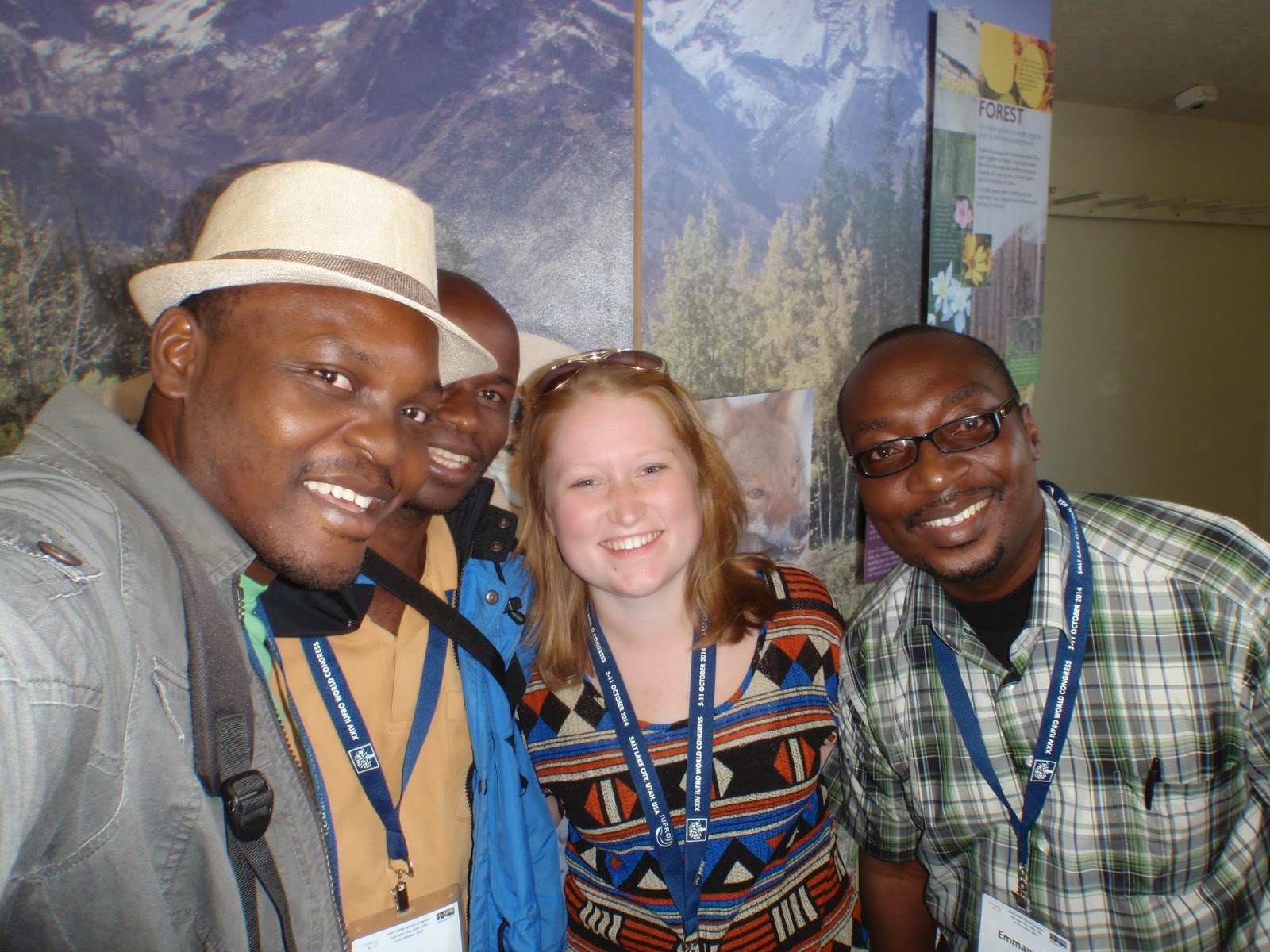
Men from Ghana and Kenya


SAF Lunch break in SLC

View from my plane ride to Portland